
Agents that test what matters first.
Two commands run QA in the coding agent you already use. Your agent reads TestChimp’s measured QA posture, from your requirements, your real users and production, spends its effort on the gaps that matter, and keeps CI fast with smart smoke.
14 days, no credit card. Works with any coding agent.
Problem
Agents can write any test.Which one should they write?
Give an agent a codebase and it will happily write hundreds of tests, mostly for the easy paths. The signals that say where testing matters, error rates, slow endpoints, the flows users depend on, the weak areas of the product, sit in dashboards nobody had time to read. Now the one writing the tests can read all of them.
The loop, run by your own agent.
TestChimp doesn’t bring its own tester. It gives the coding agent you already use the commands, the context and the measurements to do QA well.
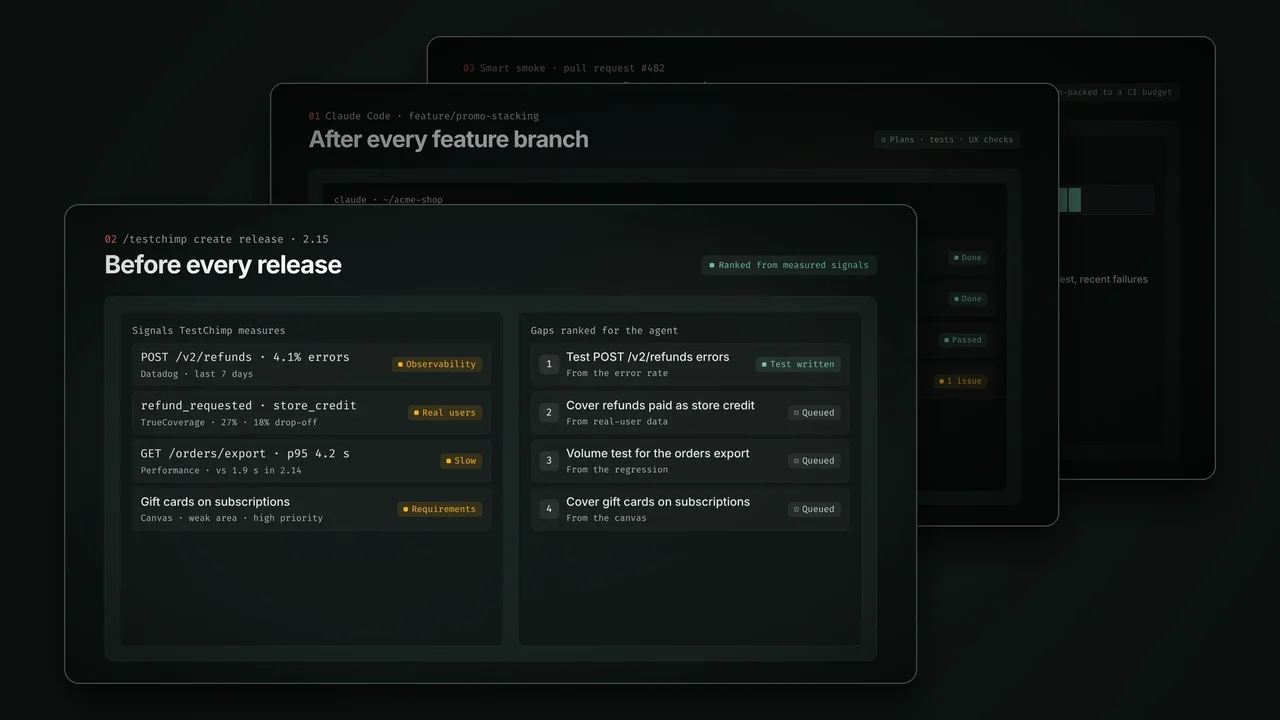
/testchimp run QA
After every feature branch.
Plans updated for what changed, instrumented tests written and run, and UX checks on the affected screens.
Plans · tests · UX checks
/testchimp create release
Before every release.
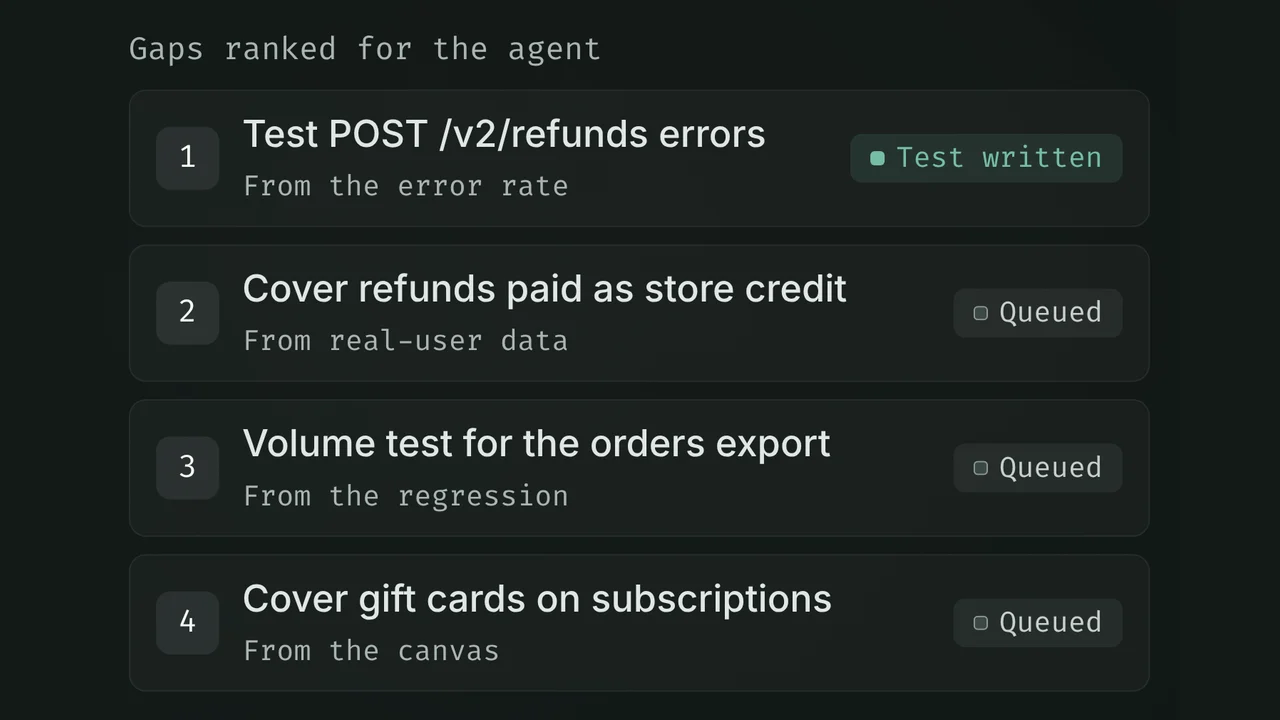
Creates the release, closes the gaps ranked from measured signals in order, then runs the suite, performance and security checks and UX walks, so the release’s QA posture is in one view.
Ranked from measured signals
Smart smoke
The best tests for the time you have.
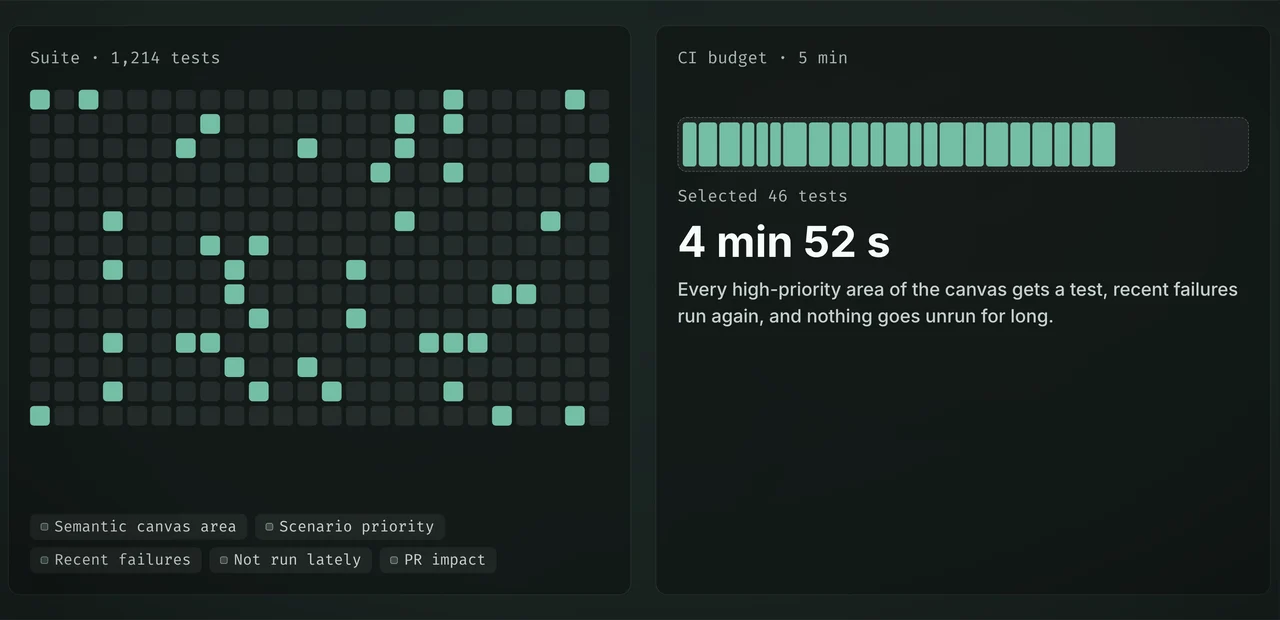
For every pull request, the highest-signal set of tests that fits the CI budget you set.
Bin-packed to a CI budget
One command after every branch.
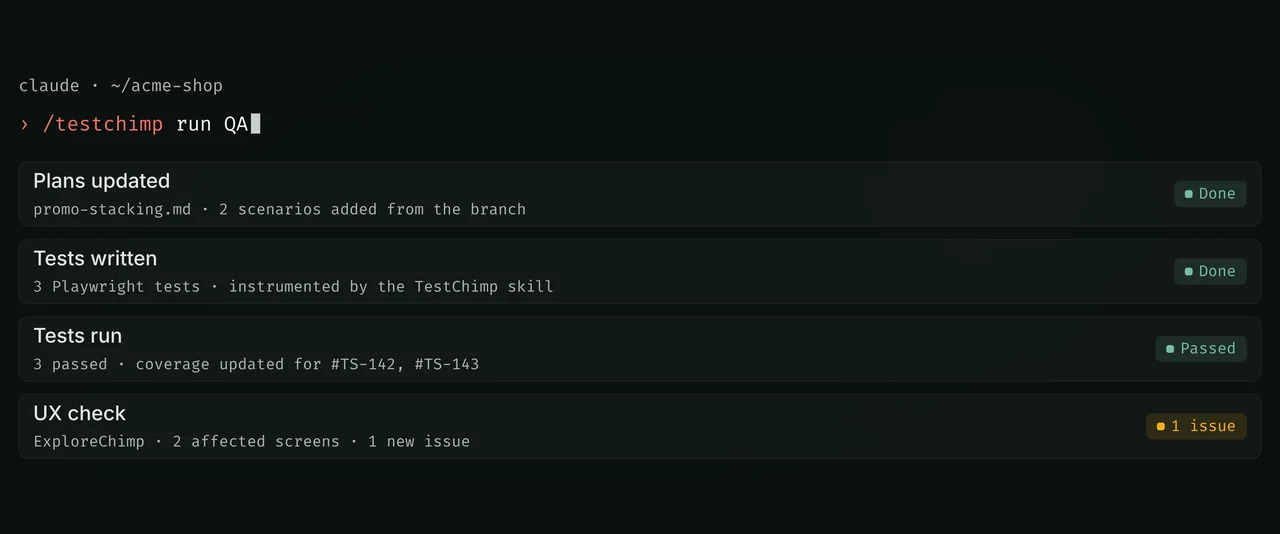
/testchimp run QA
Updates the plans for what the branch changed, writes instrumented Playwright tests against them, runs them, and has ExploreChimp check the screens the branch affected. Your agent does the work in your repo, where you review it like any other change.
Measurements people never had time to act on.
Deciding what to test next used to mean reading five dashboards, so mostly nobody did. Agents can read all of them, every time. TestChimp exposes your QA posture to them through its MCP, so effort goes where it pays.
/testchimp create release, before every release
Create release ranks the gaps by what they risk and hands them to your agent in order, then runs the suite, the performance and security checks and the UX walks the release needs. Connect your observability data and endpoints erroring in production get tests for their error paths, slow endpoints get performance tests, and high-traffic ones get more thorough coverage.
- Observability from Datadog, CloudWatch or Honeycomb.
- Weak areas of the semantic canvas, weighed with scenario priority.
- Every gap closed, ignored or tracked as an issue.
Four signals from real users.
TrueCoverage measures four signals for every user event, and breaks coverage down by each value of the event’s metadata, so agents test the slices of behaviour that matter, not just the event.
Demand
How often it happens.
High-demand events are the parts of the product people use most. They deserve strong regression coverage.
Depth
How far into the journey.
Top-of-funnel events gate everything after them, so a gap there costs more.
Duration
How long people spend.
Long interactions usually mean complex features, with more variations and edge cases to test.
Drop-off
Whether people leave after it.
Abandonment can point to an untested variation or a usability bug. Testing around it moves retention.
Keep CI fast as the suite grows.
Agents add tests quickly, and a suite that runs on every pull request soon takes too long to wait for.
Smart smoke
Set a time budget and smart smoke picks the tests to run. It bin-packs for the budget while covering as much of the semantic canvas as it can, weighed with scenario priority, recent failures, what the pull request touches and how long since each test last ran, so no test goes unrun for long.
Set up once, in your own agent.
Install the TestChimp skill and MCP in Claude Code, Cursor, Codex, Kiro or GitHub Copilot. The skill teaches your agent how to plan and test; the MCP gives it your measured posture.
After every feature branch
/testchimp run QAUpdates the plans for what changed, writes traceable tests against them, and runs UX checks with ExploreChimp.
Before every release
/testchimp create releaseCreates the release, closes the gaps that matter most, runs the suite, the performance and security checks and the UX walks, and shows the release’s QA posture.
How tests usually get chosen.
| Agents without context | AI testing services | Suites planned by people | TestChimp | |
|---|---|---|---|---|
| Uses the coding agent you already have | Yes | No | No | Yes |
| Prioritises from production and real-user signals | No | Partly | Partly | Yes |
| Measures what the tests actually cover | No | Partly | Partly | Yes |
| Tests stay plain Playwright in your repo | Yes | Partly | Yes | Yes |
| Keeps pull request runs within a time budget | No | Partly | Partly | Yes |
AI testing services: QA Wolf, Momentic and similar.
Questions about the loop.
Which coding agents does this work with?
Which observability tools can I connect?
What is smart smoke?
Do I have to change my CI?
Can tests use plain-English steps?

Your agents write the tests. TestChimp tells them which ones.
Install the skill and MCP once. After that, QA is two commands.
14 days, no credit card.