
Know what this release did to speed and security.
Your agent writes and runs k6 load and volume tests and the security scans. TestChimp compares every result with past releases, so a slower endpoint or a new vulnerability shows up before you ship, not after.
14 days, no credit card. Works with any coding agent.
Problem
Built for the demo.Broken by real traffic.
Coding agents optimise for code that works now. They fetch every row instead of a page, query once per item, skip the index, leave a database rule open or a secret in config. On test data with ten users it all passes. Then real traffic arrives, or a customer with years of data, and the vibe-coded app that passed every functional test falls over in production.
- more excessive I/O operations in AI-written pull requests than in human ones
- 8×
- more issues per pull request when the code is AI-written
- 1.7×
- of coding tasks where AI-generated code introduced a security flaw
- 45%
CodeRabbit, State of AI vs Human Code Generation (470 open-source pull requests, December 2025). Veracode, 2025 GenAI Code Security Report (80 tasks, over 100 models); its 2026 update found the average security pass rate unchanged at 56%.
Where agent shortcuts break at scale.
None of these fail a functional test. They fail when the app meets production: more users, more data, or someone looking for a way in.
More users
Work that waits on everything.
Synchronous calls on the request path, no timeouts or caching, one connection pool shared by every request. Fine for one tester; a queue at a few hundred users.
Caught by load tests
More data
Queries that grow with every row.
Unpaginated lists, a query per item, filters on unindexed columns, exports built in memory. Fast on seed data; slow, then failing, for your largest customers.
Caught by volume tests
Someone looking
Defaults that ship as they are.
Open database rules, missing authorisation checks, secrets in code, unescaped output and outdated packages. Nothing breaks until somebody tries.
Caught by security scans
Performance, compared with the last release.
The TestChimp skill writes performance tests in k6, scaffolded with a reporter that sends every result back to TestChimp. Results attach to the release, so you can lay any past release’s run of the same test over this one.
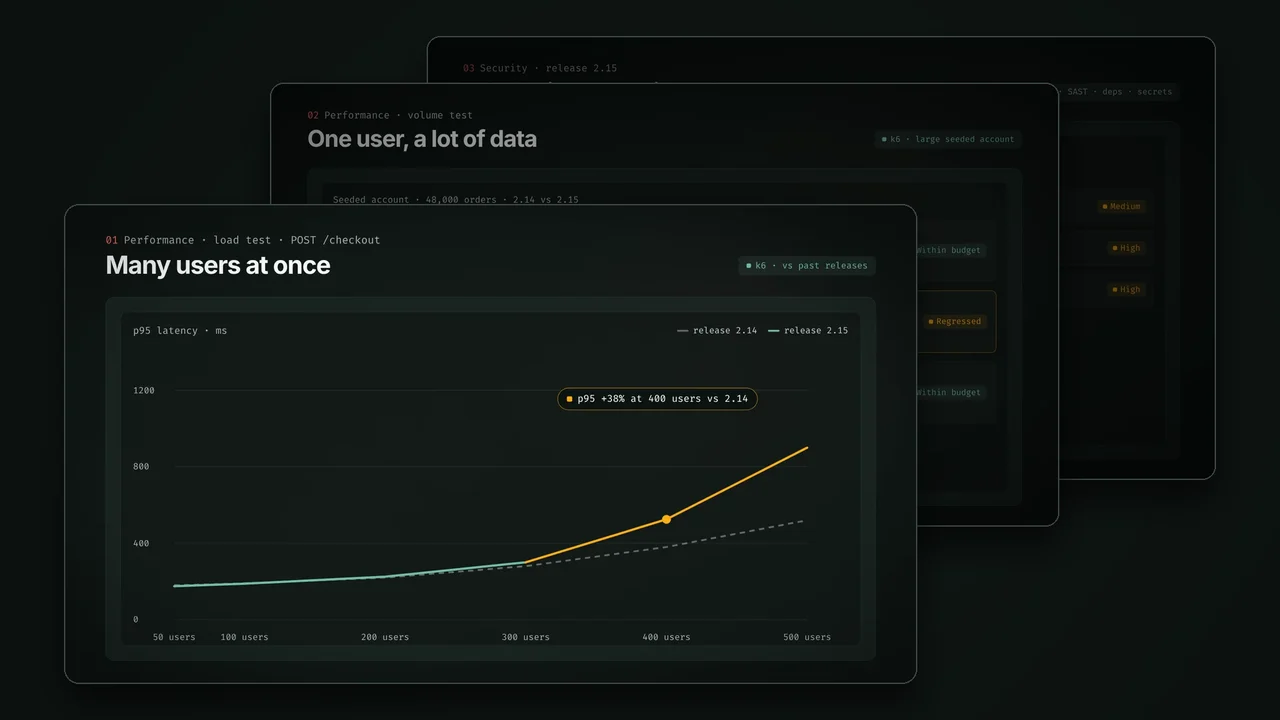
Load: many users at once
Ramp virtual users on a flow and watch latency as the load grows. When this release bends away from the last one, you see where, by how much, and on which endpoint.
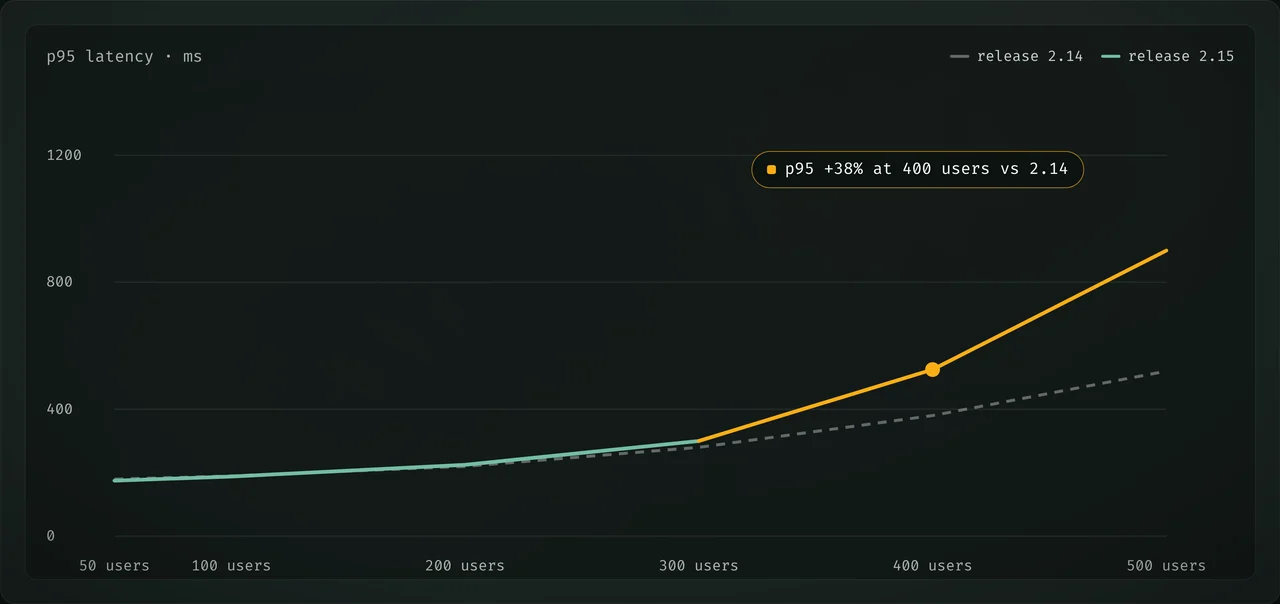
Volume: one user, a lot of data
Seed an account the size of your largest customer and run the flows they use. An export that took 1.9 seconds last release and 4.2 now is caught here.
Security findings, scoped to the release.
Create a security check in TestChimp with its scope and type, copy its command from the release checks, and run it in your coding agent. The agent runs the scanners and reports the findings back.
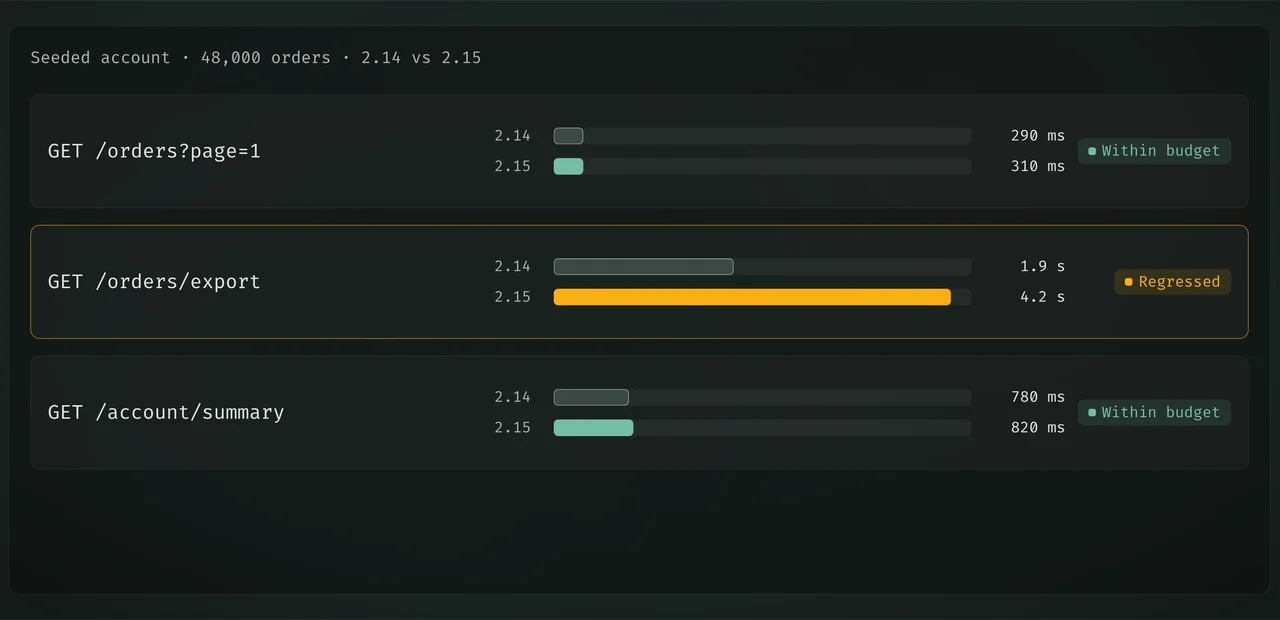
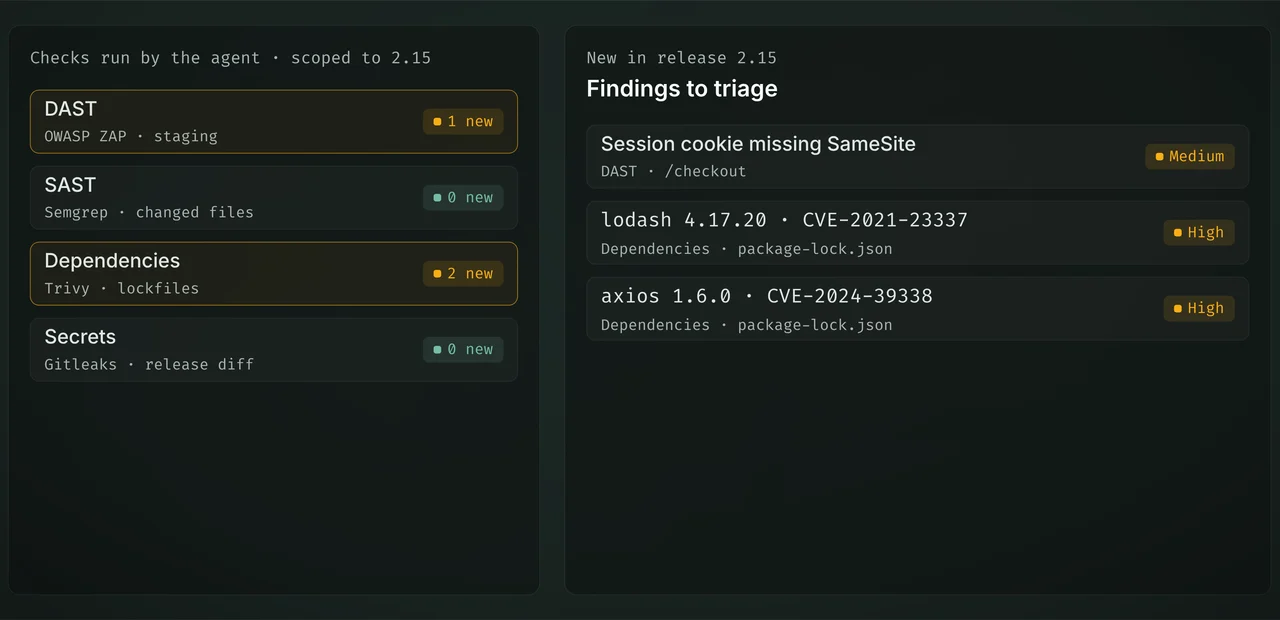
Four scanners, one list
Dynamic scans of the running app with OWASP ZAP, static analysis with Semgrep, dependency vulnerabilities with Trivy and leaked secrets with Gitleaks. Findings are consolidated per release, so you triage what this release introduced.
- DAST, SAST, dependencies and secrets.
- Findings deduplicated across runs.
- Triaged beside UX and functional issues in the release.
The same commands as functional testing.
Performance and security run through the TestChimp skill in the coding agent you already use.
Once per repo
/testchimp init perf testsScaffolds k6 and the TestChimp reporter, so results land in the release.
For a story, a scenario or a branch
/testchimp author perf testsWrites performance tests for the scope you give. On a feature branch, the agent works out the impacted areas itself.
Before a release
/testchimp run perf testsRuns the tests and reports results, ready to compare with past releases.
For each security check
/testchimp run security check <config id>Runs the scans configured in TestChimp for that check and reports the findings against the release.
How non-functional checks usually run.
| Standalone load tools | Separate security scanners | Production monitoring | TestChimp | |
|---|---|---|---|---|
| Tests written by your coding agent | No | No | No | Yes |
| Compared with past releases | Partly | No | Partly | Yes |
| Findings scoped to the release | No | Partly | No | Yes |
| Catches regressions before users do | Yes | Yes | No | Yes |
| In the same release view as functional tests | No | No | No | Yes |
Questions about security and performance.
Why do vibe-coded apps fail in production?
Is AI-generated code secure?
Is AI-generated code slower?
Do newer or bigger models write more secure code?
How do I load test an app built with AI coding agents?
What is the difference between load and volume testing?
Which tools do the tests and scans use?
Do the tests live in my repo?
How are regressions found?
Where do findings go?

Ship releases that are as fast and as safe as the last one.
Three commands for performance, one for security, and every result compared with the release before.
14 days, no credit card.